If there’s one topic horror writers never seem to get tired of, it’s what happens after we die. Honestly, that makes perfect sense. Death is the biggest mystery we face, and horror has always been the genre most willing to poke it with a stick and ask, “What if?”
For horror writers, the idea of life after death isn’t always about faith or religion. More often, it’s about possibility. What if death isn’t the end? What if something lingers? What if the story keeps going, even when the heart stops beating? Those questions are irresistible when you’re trying to scare or unsettle someone.
Ghost stories are the most obvious example. Spirits hang around because something went wrong. A wrong wasn’t righted. A secret remained buried. A promise was broken. That idea taps into a very human fear. That we don’t get closure, even in death. Horror takes that fear and gives it teeth.
What’s interesting is that horror writers don’t usually paint the afterlife as comforting. You won’t find many cozy clouds and harps. Instead, you get unfinished business, strange, in between places, or worlds with rules no one fully understands. That uncertainty is the point. Not knowing is far scarier than any clear answer.
A writer’s personal beliefs often sneak into these stories, whether they mean them to or not. Writers who believe in an afterlife might treat death as a doorway. Sometimes beautiful, sometimes terrifying. Writers who don’t might frame a haunting as emotional echoes. Grief that won’t let go, guilt that refuses to stay buried. Either way, horror becomes a way to process big, uncomfortable thoughts without needing to solve them.
That’s the real appeal. Horror doesn’t demand answers. It lets us sit with the questions. It gives us permission to wonder what happens next and to admit that the idea scares us.
In the end, horror writers return to life after death for the same reason readers do. Because we’re curious, and because we’re afraid. The tension between endings and aftermaths is where horror lives. Maybe death is silence. Maybe it’s an echo. And maybe the scariest possibility of all is that something is still listening when we think the story is over.
We continue the story of J is for Jogah. You may have noticed I’m borrowing a bit from one of the masters when the story delves into an exploration of seeing someone’s ability, Like the shine Stephen King made famous in The Shinning. Of course aren’t we all standing upon the shoulders of giants when we write. I also feel I’ll be expanding the idea of the little people into a novella length work sometime in the future. Without further adieu let’s get into it.
Continued from 03/04/2026
As he lay in bed the aroma of fresh baked blueberry muffins reached him. Getting up he passed down that shadowy hallway to the stairs and started down the steps in his spiderman pajamas. When he spotted the movers bringing in boxes and the last of their furniture he retreated to his room to change into a pair of jeans and a tee shirt.
In the kitchen he found his mom working on the small island while his dad was on the porch talking with the movers who were nearly finished.
“They’re not done yet,” she said as he entered the kitchen and he turned to join his dad on the porch. As he crossed through the living room he came upon the older man who had just placed a large cardboard box on a pile of similar boxes along one wall. As Jeffery passed through the room his attention was again drawn to that little door as an unsettled sensation filled him. Something could get in that way. Something that might be able to hurt them.
“If you don’t look at them directly they won’t hurt you,” the older man said,
“Who?’ Jeffery asked.
“The little people.”
“What little people?”
The older man smiled as he knelt beside him. “When I was a kid growing up, a little older than you, my grandmother told me about the little people. Only she called them Jogah. She was pure blooded Oneida, the native American Indians who once ruled this land.”
“She was a real Indian?” Jeffery asked.
“As real as they come, the Jogah lived in the forest and sometimes played tricks on the braves who would go into the forest for food. But they were never mean, not unless you stared at them. I guess they were a little peeved about being so small.”
“Tell your dad the muffins are ready,” his mother said as she stuck her head through the door into the living room.
“Just remember that you’ll be able to see them. They don’t mean any harm, but when you do see them, don’t stare.” With that the older man pushed himself to his feet and joined his dad on the porch. He wasn’t sure if he should believe that the older man said. After all his dad told him the door was for milk deliveries back in the old days. One or the other was lying and he was confident his dad wouldn’t lie to him. Maybe the older man liked telling stories to scare little kids. But he’d told him about his talent.
His mom joined them on the porch with a basket of blueberry muffins while his dad had set up the coffee pot, a thank you to the men who moved them for a job well done.
Jeffery helped himself to one of the muffins, the aroma making his mouth water in anticipation as he took a big bite. A blueberry popped into his mouth as he chewed, but it was missing the sweetness that would have normally flooded his senses. Instead, a saltiness cramped his mouth and his stomach as he looked down at what remained of the blueberry muffin. Spots of deep blue marked where the blueberries resided in the cake texture. One of the blueberries opened like a tiny eye, watching him with an unnatural stillness as his heart climbed into his throat and he threw the muffin to the floor of the porch with a startled cry. The muffin bounced once before coming to rest with the eaten part exposed while the eye lay there watching him as his mother and father raced to his side to see what was wrong.
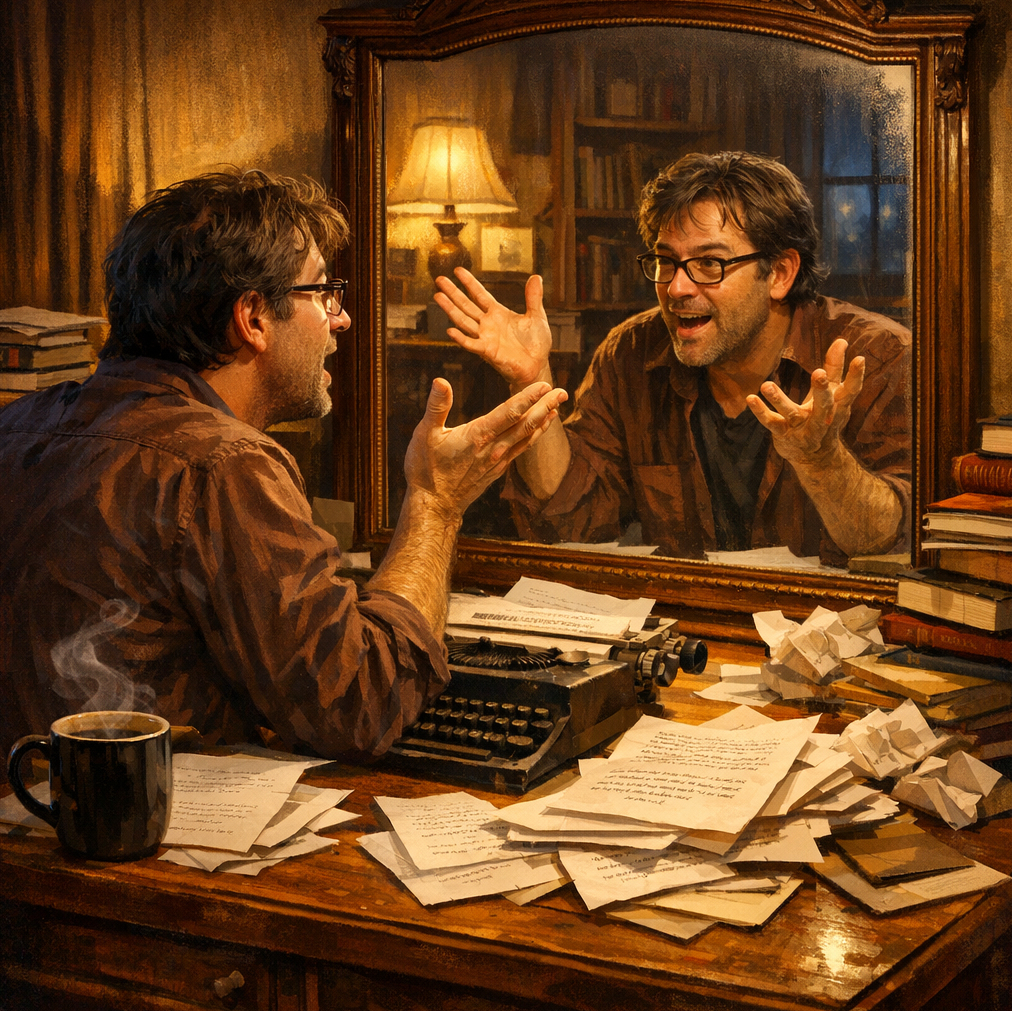
As a writer ages time becomes more malleable, seeming to have changed shape while we are distracted. The hours may feel longer in some cases while for others, me included, the hours fly by. The years pile up behind us like heavily edited manuscripts, full of red, and sometimes regret at missed opportunities. Writing stops feeling like a ladder we climb towards some lofty goal, and more like a comfortable chair we sink into with an honest familiarity.
When I started in 1991 I belonged to a small group of writers who met monthly via snail-mail. We called ourselves the Night Writers and worked to hone our craft while encouraging and celebrating the achievements of the other members. I recall one discussion in which we talked about aging, and the strong possibility of not hitting the goals we sought until we were well into our sixties.
This past December I celebrated 67 trips around the sun, and I’m still plugging away, searching for that one elusive story that will put me over the top. The one I’ve been chasing since the day I started pouring out my soul on the typewriter.
When we’re young, we write to prove we’re here. Later, we may write to understand what being here means. Age doesn’t only bring loss. It brings angles. The same childhood kitchen, the same first job, the same arguments you swore you’d never repeat. Looking back, they reveal the patterns you couldn’t see while you were living them. Mostly because you were too busy being dramatic.
That widened perspective is not nostalgia, but material.
Memory frays. Names go missing. Dates slide by the wayside. You can walk into a room with purpose then stand there like an actor who’s forgotten their line. Writing in old age doesn’t have to pretend to be a ledger. In fact, the gaps can become part of the form. You can write around what you can’t recall, noting the blank spaces the way you’d notice a torn page, with curiosity rather than shame. Sometimes the truth lives in the feeling you can still summon, or in the questions that remain after the facts have softened.
The work may need to adapt. A daily ritual can be smaller now, two pages instead of ten, fifteen minutes instead of an afternoon. Of course, afternoons may now include an appointment for your knees. You discover large-print settings, a better lamp, a softer chair, or dictation when fingers ache. These aren’t compromises so much as craft decisions that keep the door open. The goal is continuity, not heroics. Keep a notebook within reach. Draft letters you may never send. Start with a single sensory detail. The sound of a screen door. The smell of rubbing alcohol. The color of late winter light, or the mysterious creak you swear the house is making just to get your attention.
Old age also changes the question of audience. You may still publish, still chase polish and acclaim, still argue with a paragraph the way you once argued with a teenager (and yes, the paragraph is winning). But you might also write for a grandchild who hasn’t been born yet, or for the friend you miss, or for yourself on a day when the world feels narrow. Writing becomes a way to keep company. An intimate conversation with your own mind, conducted in sentences that can be revisited when words are hard to find out loud.
In the end, writing and old age share a quiet discipline. Paying attention. To what endures, to what changes, to what you can still choose. A paragraph is small, but it is a decision, an act of shaping experience rather than letting it simply pass. If the body insists on limits, the page can offer range. And if you keep writing, even in brief bursts, you’re not only recording a life; you’re continuing it. One sentence at a time. Preferably before you put down your pen and wonder where it disappeared to.
1 Before everything happened, how would you describe your life?
Mark: I’d say it was fragile. Not broken, just fragile. I’d done time, yeah. I’d screwed things up, no denying that. But I was trying. Working nights, keeping my head down, doing what I was supposed to do. Every day felt like I was walking a tightrope. One bad step and I’d go back to where everyone expected me to be.
2:You were a Marine. How did that part of your life stay with you?
Mark: The Marines teach you how to endure. You learn to keep moving even when you’re empty. That helped me survive in prison. Helped me survive afterward. But it doesn’t teach you how to stop wanting more. That part never shuts off.
3: Money was tight. How much pressure were you under at home?
Marl: Every damn day. Bills, rent, and Jenny chasing bingo jackpots like they were a lifeline. I didn’t blame her. We were both desperate. You wake up every morning knowing you’re one missed paycheck away from losing everything. That kind of pressure changes how you think. It narrows your world.
4: Let’s talk about the basement. When you hit the metal, what went through your mind?
Mark: Hope. Pure hope. I know that sounds stupid, but that’s the truth. I thought, This is it. Scrap metal, buried junk, something I could sell. I didn’t think “danger.” I thought “rent paid.” I thought maybe, just maybe, I could finally stop drowning.
5: At what point did you realize it wasn’t normal?
Mark: When it didn’t look like anything I’d ever seen. No rust. No seams. No decay. It didn’t belong there or anywhere else. But by then I was invested. That’s the thing people don’t understand. Once you convince yourself salvation is inches away, you stop asking whether you should keep digging.
6: The insects appeared shortly after. How did that moment feel?
Mark: Wrong. Not scary at first, just wrong. Like reality slipped sideways. When that thing hit my arm… I knew. I knew something had crossed a line that couldn’t be uncrossed. And then it was inside me. After that, fear didn’t matter anymore.
7: What happened once the parasite entered your body?
Mark: Imagine your thoughts aren’t yours anymore but you can still hear them arguing. I felt stronger. Clearer. The pain stopped. The fear stopped. But something else took its place. A voice. Not talking exactly, it was more like agreement. Like a crowd deciding for you.
8: You resisted at first. Why?
Mark: Because part of me knew it was lying. It showed me things. Worlds, memories, power, but it didn’t show consequences. And I knew, deep down, that anything offering that kind of escape always takes more than it gives.
9: Do you regret digging up the object?
Mark: Yeah, but regret assumes I’d have walked away if I’d known. And I’m not sure that’s true. I was tired of being small. Tired of losing. That thing fed on that hunger. It didn’t force me, it used me.
10: If someone hears this and finds something like what you found, what would you tell them?
Mark:Don’t touch it. Don’t believe it when it promises answers. Don’t believe it when it tells you you’re special. Some doors exist because they’re meant to stay closed.
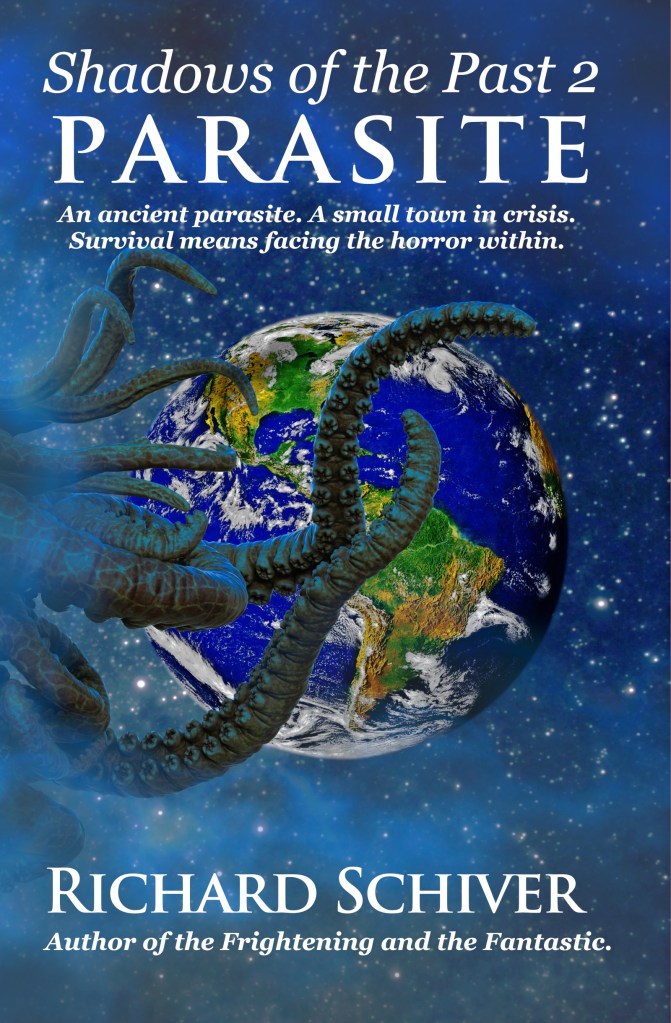
Mark and his wife Jenny appear in Parasite: Shadows of the Past II An ancient parasite. A small town in crisis. Survival means facing the horror within.
Click on cover for more info
When bullied teen Anthony finally stands up to his tormentor Randy, a violent confrontation leads to a tragic accident. Something ancient and inhuman awakens in the aftermath. As Randy’s broken body is invaded by a bizarre, otherworldly parasite, a wave of grotesque transformations and unexplained violence sweeps through Garret County, Maryland. Deputy Sam Hardin, haunted by his own past encounters with the supernatural, is drawn into a spiraling nightmare as children go missing, birth defects surge, and a strange, predatory animal stalks the woods. Meanwhile, a prospector in Tennessee stumbles upon a buried alien machine, and a series of grisly incidents across the country hint at a spreading infection that threatens all of humanity.
Told through the intersecting lives of traumatized families, desperate law enforcement, and ordinary people caught in extraordinary circumstances, Parasite explores the terrifying consequences of an ancient evil unleashed. As the parasite’s influence grows, turning victims into hosts and spawning monstrous hybrids. Sam and his gifted son Frankie must confront the horror head-on, racing against time to contain a threat that could spell the end of mankind.
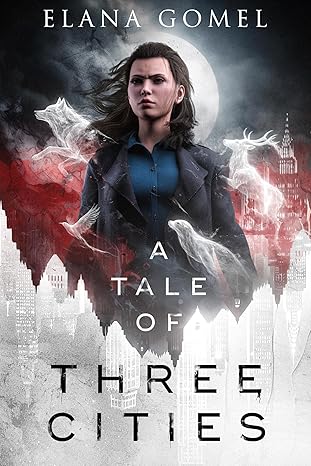
Synopsis: In a city built on myth and soaked in rain, truth is the most dangerous thing you can find.
When a women’s corpse explodes in the rain outside the Temple and floods half the Hill, Mara Raven is pulled away from the search for her missing husband and back into the job she never for: using her strange Power to fish for killers in a city rotting from the inside out.
Mara Raven doesn’t believe in gods or monsters. The only thing she puts her faith in is the dream-sea — an eerie, otherworldly current only she can dive into, dragging up secrets others prefer to stay buried. The Temple wants silence, preferring to pray to the Slaughtered Ones, long dead ancestors Mara doesn’t believe ever existed. The constables want results. And someone else, known only as the Revealer, wants to open the ancient Gate to the so-called Abode of the Ancestors, an act which may prove disastrous.
As the city drowns in its myths and murder, Mara follows a trail of blood, lies, and twisted devotion as nightmares from the dream-sea begin to bleed into reality. A seal has been broken. Something is coming through that Gate, and it’s not forgiveness for the city’s sins.
Dark, hallucinatory, and sharp as broken glass, A Tale of Three Cities is a speculative noir mystery for readers who like their heroines mad, bad, and haunted.
About the Author
Born in Ukraine and currently residing in California, Elana Gomel is an academic with a long list of books and articles, an award-winning writer, and a professional nomad. She has taught in Israel, Italy, and the US, and is known in the academy for her (purely theoretical) interest in serial killers, alien invasions, and rebellious AIs.
Her upcoming academic publication is Palgrave Handbook of Global Fantasy. She is the author of more than a hundred stories, several novellas, and five novels of dark fantasy and dark science fiction. Several of her stories appeared in Best of the Year anthologies. Her most recent publications are Nigtwood, a novel of fairy tales and exile, and the collection My Lady of Plagues and Other Gothic Fairy Tales. She is a member of HWA.