Tag: writing

  • Weekly Writing Challenge 02/04/2026 I Am.

    Weekly Writing Challenge 02/04/2026 I Am.

    Gus backed away from the three men, then turned and fled towards the only building that had any color in his featureless world.

    “He’s got a gun, get him.” He heard the shouts behind him as he fled across the open ground. A farmhand appeared at the door before him, his relaxed features giving way to sudden surprise when he found himself staring down the muzzle of the pistol as Gus pushed past him into the interior of the building.

    He stopped just inside the door, his wavy reflection stretched out at his feet in the surface of the highly polished floor. A door stood to his right and as approaching footsteps came from around the bend in the hallway before him, trapped between them and the pounding footsteps that were fast approaching behind him, he slipped into the room.

    Beyond the door, on his right, stood a row of stalls. Gray walls wrapped around toilets to afford the user a degree of privacy. Opposite the stalls was a row of white porcelain sinks and above each was a mirror.

    Gus was drawn to the mirror, having never seen himself as much as he could recall, the sound of movement in one of the stalls interrupted him and he spun around with the pistol leveled at the door as a farmhand emerged from within the stall. It was the one he recognized as Brodie and he stepped towards him. His hands spread in a questioning manner as Brodie backed away.

    Gus grunted, unable to make any other sound, his hand once more going to the puckered wound on his neck, he could feel the stitches with his fingers.

    “Don’t hurt me, please,” Brodie said as he backed away.

    From the corner of his eye Gus caught a glimpse of his reflection in the mirror to his right as Brodie backed towards the door. It drew him like a moth to a flame and with Brodie forgotten he spun around to look at himself in the mirror. What he saw gazing back at him was the same face he’d seen upon his arrival.

    Short sandy hair crowning a face that formed a near perfect circle with wide spaced eyes, and a pug nose above a thin mouth.

    No!

    It couldn’t be, it wasn’t possible, he wasn’t one of them. He had a wife, kids, a home. He had been the assistant manager of a farmers co-op. His finger went to his throat, he fel that puckered wound, the stitches protruding from his flesh. But when he looked in the mirror all he saw was the unblemished skin of his neck.

    No!

    A commotion at the door drew his attention and he turned to confront several farmhands pushing their way through the door with weapons aimed in his direction. He lifted the pistol and aimed the shaking muzzle at them. Bullets ripped through tender flesh, spinning him around and he fell face first towards the floor, his last thoughts clinging to the notion that it had all been a terrible mistake.

    To be continued!

  • Plotting vs Pantsing: Which Writing Style Suits You?

    Plotting vs Pantsing: Which Writing Style Suits You?

    When embarking on a writing project, authors often find themselves choosing between two distinct approaches. Plotting and pantsing. Each method offers unique advantages and challenges, and understanding their differences can help writers select the path that best suits their creative style.

    Plotting: Structure and Strategy

    Plotting, sometimes called outlining, is a methodical approach where writers plan their story in advance. This can involve creating detailed outlines, mapping out character arcs, and organizing scenes before writing the first draft. Plotters benefit from having a clear roadmap, which helps maintain narrative coherence and logical progression. This structure is especially useful for complex stories with multiple subplots or intricate character relationships. Plotting can also minimize writer’s block, as the author always knows what comes next, and it often leads to more efficient revisions since potential plot holes are addressed early on. However, plotting can sometimes stifle spontaneity, making stories feel predictable or causing writers to get stuck in the planning phase without moving forward.

    Pantsing: Creativity and Discovery

    Pantsing, derived from “flying by the seat of your pants,” is a more spontaneous approach. Pantsers dive into writing with minimal planning, allowing the story and characters to evolve organically. This method fosters creativity and can lead to unexpected twists, making the writing process exciting and dynamic. Pantsers discover their plot as they write, which can result in fresh, authentic narratives. However, this freedom comes with risks: stories may lack structure, leading to plot holes or pacing issues, and writers may experience burnout if inspiration wanes.

    Choosing Your Path

    Ultimately, neither method is universally superior. Some writers blend both approaches, outlining key points but leaving room for discovery. The choice depends on your personality, project needs, and what inspires you most. Whether you thrive on structure or embrace creative chaos, understanding plotting and pantsing empowers you to craft stories in a way that feels authentic and productive.

    Plotting, or outlining, is favored by writers who prefer structure and advance planning. Notable authors who are known for their plotting methods include:

    • J.K. Rowling: Famously plotted the entire Harry Potter series before writing, using detailed outlines and spreadsheets to track characters and plot points.
    • Brandon Sanderson: Known for his intricate world-building and complex plots, Sanderson meticulously outlines his novels before drafting.
    • James Patterson: Outlines every chapter before writing, ensuring a tight, fast-paced narrative.
    • John Grisham: Plans his legal thrillers in detail, mapping out the story before beginning the first draft.
    • Dan Brown: Uses extensive outlines and research to structure his bestselling thrillers.

    These authors demonstrate that plotting can help manage complex stories and maintain consistency throughout a series or standalone novel.

    Authors Who Use Pantsing

    Pantsing, or “writing by the seat of your pants,” is embraced by writers who prefer spontaneity and organic story development. Well-known pantsers include:

    • Stephen King: Often writes without a clear outline, letting the story and characters guide the narrative. King discusses this approach in his memoir, On Writing.
    • George R.R. Martin: Describes himself as a “gardener” rather than an “architect,” preferring to discover the story as he writes.
    • Margaret Atwood: Known for allowing her stories to evolve naturally, without rigid outlines.
    • Neil Gaiman: Embraces discovery writing, letting ideas and characters develop as he goes.
    • Ernest Hemingway: Wrote with minimal planning, focusing on the flow of the narrative.

    Other notable pantsers include Diana Gabaldon (Outlander), Mark Twain, Isaac Asimov, Dean Koontz, and Hilary Mantel. These authors value the creative freedom and unexpected twists that pantsing can bring to their work.

    If you’re a writer what method works best for you? I’m more of a pantser until the work starts becoming unwieldy at which point I’ll start plotting the rest of the novel to fill in any holes.

  • A Conversation with Myself

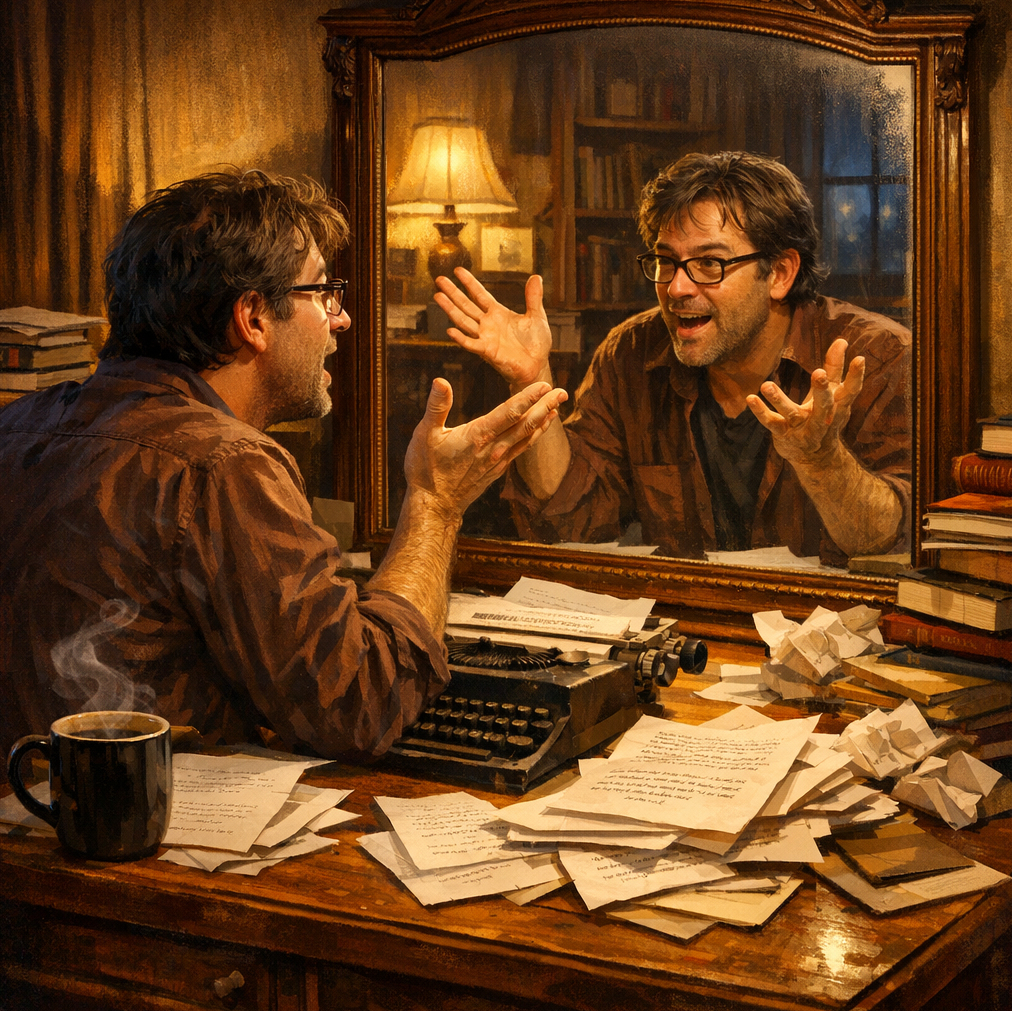
    A Conversation with Myself

    An interview with Sheriff Paul Odenton.

    Sheriff Paul Odenton appeared as a supporting character in Cursed, which I realize now I should have titled. The Curse of Porter Mines.

    1. Sheriff Odenton, you’ve served your community for decades. What first inspired you to pursue a career in law enforcement, and how has your perspective on the job changed over the years?

    When I was a young man, I believed in the idea of justice, of right and wrong being clear as day. My father always said someone had to stand up and do the hard things, and I suppose I took that to heart. Over the years, though, I’ve learned that the world isn’t so black and white. There’s a lot of gray and sometimes doing the right thing means making choices that haunt you long after the paperwork’s filed.

    2. The disappearances of children in Porter Mines have haunted your career. How do you cope with the emotional toll of unsolved cases, especially those involving the most vulnerable members of your community?

    You never really cope, not fully. Those faces stay with you. You see them in your dreams, and you hear their parents’ voices every time the phone rings. I try to remind myself that I did everything I could, but the truth is, you always wonder if you missed something. I lean on my wife, Maggie, and the folks I trust. Sometimes, all you can do is keep going and hope you make a difference the next time.

    3. Throughout the investigation, you’re confronted with both rational explanations and local legends, such as the Witch of Porter Mines. How do you balance skepticism with the need to respect the fears and beliefs of the townspeople?

    I was trained to look for evidence, to trust what I can see and prove. But in a place like Porter Mines, legends are as real as the ground we walk on. Folks need something to explain the unexplainable. I try to respect that, even if I don’t always believe it myself. Sometimes, listening to their fears is as important as chasing down leads.

    4. The events in Porter Mines often put you at odds with political pressures and public scrutiny. How do you maintain your integrity and focus on justice when facing criticism from both the community and local government?

    It’s not easy. There’s always someone looking over your shoulder, second-guessing your decisions. I remind myself why I took this job in the first place, to protect people, not to win popularity contests. I do my best to be honest, even when the truth is ugly, and I try to treat everyone fairly, no matter who’s watching.

    5. In your view, what role does the past, both personal and communal, play in shaping the present dangers and fears in Porter Mines?

    The past never really leaves us. In Porter Mines, old wounds fester, and stories get passed down like family heirlooms. Sometimes, the things we don’t talk about, like secrets and regrets are what hurt us most. I’ve seen how history repeats itself when we don’t face it head-on. That’s true for families, and it’s true for towns.

    6. You’ve witnessed the impact of trauma on families, including your own. What advice would you give to others in law enforcement about supporting victims and their loved ones through tragedy?

    Listen. Don’t just go through the motions, really listen. People need to know you care that you’re not just another badge. Be patient, and don’t make promises you can’t keep. Sometimes, all you can offer is your presence and your willingness to help them carry the weight, even if only for a little while.

    7. Now that the case has reached its conclusion, what lessons do you hope the community, and perhaps future generations of law enforcement, will take from your experiences in Porter Mines?

    I hope folks remember that evil isn’t always a stranger in the night, it can be the things we ignore, the pain we bury, or the anger we allow to fester. For those who come after me, I’d say. Never stop asking questions, never stop caring, and never forget that every case is someone’s whole world. Sometimes, the only thing standing between hope and despair is the person willing to keep searching for the truth.

    Sheriff Odenton is a persistent old man who continues to show up in various other places in my work. He briefly appeared in Parasite, part two of my Shadows of the Past trilogy, and in my works in progress, Bitter Hollow, The Bad Place, and will take the stage again in The Gathering when I get around to writing it. Which will be the last chapter in a trilogy of books that started with Cursed.

    Cursed

    Click on the cover to purchase.

    After the loss of her husband, Susan sought a safe place to rebuild a life for herself and her six-year-old daughter, Christine. Quaint and picturesque, Porter Mines seemed ideal, but Susan soon learns appearances can be deceiving. 

    Like many small towns, the history of Porter Mines was woven in a tapestry of dark secrets. One centered on a witch, who vowed with her dying breath to claim vengeance against those who wronged her. A ghost story rooted in grisly truth. 

    Can Susan protect Christine from a wrath even death couldn’t tame?

    Or will her only child fall prey to the curse of Porter Mines?

  • Weekly Writing Challenge 01/28/2026 – I Am

    Weekly Writing Challenge 01/28/2026 – I Am

    They’ll be coming soon, they’ll let me out soon. The two thoughts chased one another through his mind as the night gave way to dawn and the sounds of a new day filled the compound.

    “What about the one in the box?” One of the farmhands shouted from somewhere nearby.

    “Leave him, he hasn’t learned his lesson yet.” Came the answer that sent the first waves of panic washing through his body. They weren’t coming to open the box anytime soon, not before he learned his lesson.

    What lesson?

    He hadn’t done anything and he fought to quell the panic that threatened to turn him into a raving lunatic that would batter its flesh against unyielding steel in a mindless foray into madness.

    It won’t be much longer. He tried to convince himself but that need to stretch his legs grew with every passing moment. The steel around him became warm as the suns rays broke across the horizon. Spilling through the countryside like a river unleashed from it restraints. Running wildly as it cast long shadows for the remnants of the night to seek shelter in.

    He focused on keeping himself calm, a nerve-jangling panic thrumming just beneath the surface of his consciousness as he pressed the palms of his hands against the warming steel that was mere inches from his face.

    It won’t be much longer.

    His leg jerked spasmodically, driving his knee against the lid of his prison, coffin, and pain washed up his leg as panic and rage swelled within him. He screamed as he beat against the lid of his prison, soft flesh turning to mush against the unyielding steel as flecks of blood rained down upon his face. He thrashed back and forth, bouncing his head from unforgiving steel, his screams filling the confined space, ringing in his ears as he pummeled the lid.

    He didn’t know how long he had been screaming before the lid was lifted, he was only dimly aware of the cold gray steel replaced by a featureless blue sky. Rough hands reached into the box and pulled him to his feet, standing him next to the box where he collapsed onto the ground.

    “On your feet boy,” that familiar voice shouted and he struggled to stand as gloved hands held him steady. He was whimpering in his throat as he gazed about the compound. The featureless gray buildings that surrounded him represented his future. Endless days beneath a relentless sun and the stinging whip of the overseer. Bent to his task until he could no longer stand up straight. Scrabbling through the remainder of his short life like a deformed crab performing tricks for its master for small scraps to sustain itself.

    No!

    He looked down, catching a glimpse of a well-worn handle, the butt of a pistol sticking out of its holster on the overseer’s hip. Before reason could stop him, he reached out and snatched the pistol from the holster. He fumbled with it in his hand, not sure how to use it, relying more on instinct as he wrapped one hand around the handle and pointed the muzzle at the three farmhands who had come to take him from the box.

    “Let’s get him back to the…” the man in charge began, the rest of his sentence dying as he turned to find the muzzle of the pistol aimed at his face.

    To be continued!

  • How Everyday Life Sparks Great Writing Ideas

    How Everyday Life Sparks Great Writing Ideas

    One of the most common questions a writer hears is, “Where do you get your ideas?”

    Being the typical smartass that I am, I sometimes reply they come from the idea tree.

    But the real answer, when authors are willing to admit it, is simple, yet elusive. Ideas emerge from some of the most unexpected places. Maybe a fleeting moment, a snippet of conversation, or even a dream. For some, inspiration is rooted in personal experience or observation. Mark Twain famously based Huckleberry Finn on a childhood friend, proving that real life often provides the richest material for fiction.

    Other writers find their muse in the world around them. News stories, historical events, or even graffiti can spark that “what if?” moment that leads to a compelling narrative. Many authors, like Stephen King and Neil Gaiman, describe their ideas as arriving unbidden. Sometimes half-remembered, sometimes fully formed, yet always demanding attention.

    In his book On Writing, Stephen King spoke of ideas using the cup and the handle metaphor. How some ideas do not arrive fully formed and ready to go. But they get catalogued anyway until the idea that represents the handle or the cup arrives to complete the set.  

    But the secret isn’t just in having ideas. It’s in recognizing their potential. Writers train themselves to notice the unusual, the poignant, or the extraordinary in everyday life. They jot down stray thoughts, nurture them, and let them grow into stories. Sometimes, inspiration comes from other art forms, travel, or even the simple act of people-watching.

    For me personally I watch strangers. I work part time at Wally World, and I’ve wasted a few moments building narratives in my mind for the lives of the shoppers around me. Simple little tales that at times uncover a deeper narrative that refuses to be set aside. Like a hidden treasure trove of ideas that emerge from a simple act.

     Every writer’s process is unique. The magic comes with being open to inspiration while being brave enough to follow these ideas to where they ultimately lead. Turning ordinary moments into extraordinary tales.

    Where do your ideas come from?