Tag: stephen king

  • Plotting vs Pantsing: Which Writing Style Suits You?

    Plotting vs Pantsing: Which Writing Style Suits You?

    When embarking on a writing project, authors often find themselves choosing between two distinct approaches. Plotting and pantsing. Each method offers unique advantages and challenges, and understanding their differences can help writers select the path that best suits their creative style.

    Plotting: Structure and Strategy

    Plotting, sometimes called outlining, is a methodical approach where writers plan their story in advance. This can involve creating detailed outlines, mapping out character arcs, and organizing scenes before writing the first draft. Plotters benefit from having a clear roadmap, which helps maintain narrative coherence and logical progression. This structure is especially useful for complex stories with multiple subplots or intricate character relationships. Plotting can also minimize writer’s block, as the author always knows what comes next, and it often leads to more efficient revisions since potential plot holes are addressed early on. However, plotting can sometimes stifle spontaneity, making stories feel predictable or causing writers to get stuck in the planning phase without moving forward.

    Pantsing: Creativity and Discovery

    Pantsing, derived from “flying by the seat of your pants,” is a more spontaneous approach. Pantsers dive into writing with minimal planning, allowing the story and characters to evolve organically. This method fosters creativity and can lead to unexpected twists, making the writing process exciting and dynamic. Pantsers discover their plot as they write, which can result in fresh, authentic narratives. However, this freedom comes with risks: stories may lack structure, leading to plot holes or pacing issues, and writers may experience burnout if inspiration wanes.

    Choosing Your Path

    Ultimately, neither method is universally superior. Some writers blend both approaches, outlining key points but leaving room for discovery. The choice depends on your personality, project needs, and what inspires you most. Whether you thrive on structure or embrace creative chaos, understanding plotting and pantsing empowers you to craft stories in a way that feels authentic and productive.

    Plotting, or outlining, is favored by writers who prefer structure and advance planning. Notable authors who are known for their plotting methods include:

    • J.K. Rowling: Famously plotted the entire Harry Potter series before writing, using detailed outlines and spreadsheets to track characters and plot points.
    • Brandon Sanderson: Known for his intricate world-building and complex plots, Sanderson meticulously outlines his novels before drafting.
    • James Patterson: Outlines every chapter before writing, ensuring a tight, fast-paced narrative.
    • John Grisham: Plans his legal thrillers in detail, mapping out the story before beginning the first draft.
    • Dan Brown: Uses extensive outlines and research to structure his bestselling thrillers.

    These authors demonstrate that plotting can help manage complex stories and maintain consistency throughout a series or standalone novel.

    Authors Who Use Pantsing

    Pantsing, or “writing by the seat of your pants,” is embraced by writers who prefer spontaneity and organic story development. Well-known pantsers include:

    • Stephen King: Often writes without a clear outline, letting the story and characters guide the narrative. King discusses this approach in his memoir, On Writing.
    • George R.R. Martin: Describes himself as a “gardener” rather than an “architect,” preferring to discover the story as he writes.
    • Margaret Atwood: Known for allowing her stories to evolve naturally, without rigid outlines.
    • Neil Gaiman: Embraces discovery writing, letting ideas and characters develop as he goes.
    • Ernest Hemingway: Wrote with minimal planning, focusing on the flow of the narrative.

    Other notable pantsers include Diana Gabaldon (Outlander), Mark Twain, Isaac Asimov, Dean Koontz, and Hilary Mantel. These authors value the creative freedom and unexpected twists that pantsing can bring to their work.

    If you’re a writer what method works best for you? I’m more of a pantser until the work starts becoming unwieldy at which point I’ll start plotting the rest of the novel to fill in any holes.

  • Transforming Everyday Moments into Story Ideas.

    Transforming Everyday Moments into Story Ideas.

    I’m running a little late this week. That’s been the story of my life lately while I work to bring my post apocalyptic series to an end. Without further adieu let’s get into this.

    One of the most common questions a writer hears is, “Where do you get your ideas?”

    Being the typical smart ass that I am, I sometimes reply they come from the idea tree.

    But the real answer, when authors are willing to admit it, is simple, yet elusive. Ideas emerge from some of the most unexpected places. Maybe a fleeting moment, a snippet of conversation, or even a dream. For some, inspiration is rooted in personal experience or observation. Mark Twain famously based Huckleberry Finn on a childhood friend, proving that real life often provides the richest material for fiction.

    Other writers find their muse in the world around them. News stories, historical events, or even graffiti can spark that “what if?” moment that leads to a compelling narrative. Many authors, like Stephen King and Neil Gaiman, describe their ideas as arriving unbidden. Sometimes half-remembered, sometimes fully formed, yet always demanding attention.

    In his book On Writing, Stephen King spoke of ideas using the cup and the handle metaphor. How some ideas do not arrive fully formed and ready to go. But they get catalogued anyway until the idea that represents the handle or the cup arrives to complete the set.  

    But the secret isn’t just in having ideas. It’s in recognizing their potential. Writers train themselves to notice the unusual, the poignant, or the extraordinary in everyday life. They jot down stray thoughts, nurture them, and let them grow into stories. Sometimes, inspiration comes from other art forms, travel, or even the simple act of people-watching.

    For me personally I watch strangers. I work part time at Wally World, and I’ve wasted a few moments building narratives in my mind for the lives of the shoppers around me. Simple little tales that at times uncover a deeper narrative that refuses to be set aside. Like a hidden treasure trove of ideas that emerge from a simple act.

     Every writer’s process is unique. The magic comes with being open to inspiration while being brave enough to follow these ideas to where they ultimately lead. Turning ordinary moments into extraordinary tales.

    Where do your ideas come from?

  • Embracing One-Star Reviews: A Writer’s Perspective

    Embracing One-Star Reviews: A Writer’s Perspective

    My apologies, I got so caught up in yesterday’s football games I failed to write today’s post. So I’m dredging up this old post from the stone ages of self-publishing and touching it up a bit for today’s audience.

    It was bound to happen eventually. It happens to every writer who puts themselves out there.  No one is immune.  Not even F. Scott Fitzgerald, whose novel, The Great Gatsby, has received a total of 162 one-star reviews. Stephen King is known the world over as a writer worth reading. Yet his novel, The Stand, considered by some to be one of the best post apocalyptic stories ever written, has gotten 245 one-star reviews. 

    Every writer gets them. Everyone. And I’m no different. I’ve gotten several on some of my earlier works, as well as my more recent works.

    Does it bother me? Not in the least, and I only mention it to make a point. If one wishes to be a writer, singer, painter, dancer, actor, or anyone who puts themselves out in the public eye, you need a thick skin. Because not everyone is going to like your latest masterpiece.

    But I as a writer do take one thing from these one-star reviews. The reviewer, for all their loathing, did finish the story. Even though they didn’t like it, they admitted to reading to the end.

    How a writer responds to a one star, or a bad review, can become the stuff of legend in this day of instant communication coupled with the anonymity of the Internet.

    I’m personally aware of a writer who used sock puppets to attack anyone who dared impinge upon the quality of his work. I discovered this when the author in question reviewed my work in a couple of different places. In one place he posted the review under his sock puppet, while in another place he posted the exact same review, word for word, under his real name. I guess he wasn’t really paying attention that day.

    Upon closer examination I discovered that the writer had reviewed his own work in addition to attacking anyone who dared give his work less than four stars. In case you’re wondering his work was self-published.

    Overreacting to bad reviews is not restricted to those who self-publish.

    Anne Rice is well known for her Vampire Chronicles that have sold millions of books worldwide. When Blood Canticle was released many of the readers who had been waiting for the book were less than thrilled and responded with negative reviews. At the time of the writing of this original post there were 109 one-star reviews out of a total of 406 reviews on Amazon. Anne’s response was not nice. I’m not going to share any links here but if you do a search you can find out everything that happened.

    While researching this post I discovered that self-published authors are more inclined to get into a fight with reviewers than those who have followed the traditional route. Sadly, this leads many people to frown on self-publishing. And reviewers may refuse to review self published works for fear of being confronted.

    I’m no expert but I personally believe it may be because those who have followed the traditional route have endured rejection by editors in the past, yet continued to submit, thereby thickening their skin, and preparing them for bad reviews. With some exceptions.

    While those who self-publish may not have experienced rejection until they are reviewed by the public who are known to not pull any punches when it comes to letting others know how they feel about a product they’ve paid for. Does this mean I frown on self-publishing? Absolutely not. Back when this post was written self-publishing carried a stigma that was slowly being erased. I’m just making an observation from my time in writing and publishing. I’ve been writing off and on since the early 90’s. A computer failure in 2001 wiped out ten years of hard work and put me off from writing for some time, but I’m back and going after it as hard as time and money will allow.

    I’ve self-published in the past and will continue to do so. Anymore it seems like the smartest route for most people. Yet I still submit to those publishers open to submissions, and I did get one of my works published by Severed Press that has since reverted back to me.

    As a writer, how does a negative review make you feel?

    If the book or story you read was bad, do you post a negative review?

    If not, why?

  • Upon The Shoulders of Giants

    Upon The Shoulders of Giants

  • Exploring Time Travel in 11/22/63 by Stephen King

    In 11/22/63, written by Stephen King, the hero of the tale, Jake, is shown a portal to the past. It’s where Al, the proprietor of the small diner where it was located, has been buying his hamburger, taking advantage of the price. Offering a much better reason for his lower prices than was generally believed by those who thought he was using stray cats and dogs. It’s here we get to the gist of the story. Al enlists Jake’s help to save President Kennedy from his assassin. Those who have read the story know what happened. I don’t want to post any spoilers, so I’ll leave it at that. If you’re wondering what happened, go grab the book, it’s worth the read.

    It’s a pretty good tale that grows into your typical King story that he is well known for. It also serves to make one wonder about alternate realities and the multiverse. Theoretical physicists have proven, via math, that alternate realities do indeed exist. Not every physicist subscribes to the theory, but it’s out there. Some believe every event, or decision, creates a new branch in the timeline.

    It’s here where things really start to get muddled. I’m sure there’s not a  limit to the number of timelines branching from each of the others, creating a swarm of timelines traveling in multitudes of directions.

    Could you imagine the headache that would cause to whoever had to keep these things straight.

    One of the first things you come up against is what triggers the timeline to branch off? Is it major events, such as the aforementioned assassination of a sitting president, or does the timeline branch based on either/or decisions? If so, is it a worldwide phenomenon, or say a collective decision? Or is it a more personal one.

    On the one hand you have a solitary timeline with other timelines branching off of it with every major event in the world. If it’s a more individual level, does the branching occur at major intersections in one’s life, or does the branching occur based on everyday decisions and changes in our routine.

    Like something as simple as forgetting to turn off a light causes you to leave the house thirty seconds later than you normally would. Now we have dual timelines for your departure where in one you arrive safely to your destination, while in the other you’re delayed by an accident, or possibly involved in one yourself.

    It starts to get really confusing when you consider all the possibilities occurring at every juncture in your life.

    The biggest question of all is what forces are at play to create the branch? Is it a mechanical process that requires extreme amounts of power, or does it use a type of power that for a lack of a better word we might call magic?

    Say these portals do exist. Are they visible? Are they permanent? Do they move? What would happen if somebody accidentally walked into one? Would that explain some of the assorted mysterious disappearances that have occurred over the years? Maybe it’s an explanation for the assorted mysterious strangers that have appeared throughout history.

    You would think these portals would have to be in remote locations to prevent major problems. Could you imagine one appearing in the middle of New York City during rush hour. That would be one hell of an excuse for missing work. Sorry I couldn’t make it in today. I fell into the stone age and couldn’t find my way back right away.

    It’s all just more fodder for the what if machine operating at the center of every writer’s mind. Of course it’s not really restricted to writers, as most people run into situations and events that prompt them to wonder, what if?

    But it’s usually the writer who takes that idea, throws a few characters into the mix, and hits the blend button. As a writer myself I’m always running into these what if moments. They fuel my fiction and inspire me to try harder.

    One such event occurred recently when my wife and I were visiting our grandson, he has two children of his own, a little boy, and a little girl. The boy is four, and his little sister is nine months old. I caught him looking at her, and the expression on his face was one of pure love. In my mind I saw them fifty years from now having to say goodbye to one another. It hit me pretty hard on the emotional level.. It’s one of those moments that will remain with me as my subconscious comes up with a vehicle to carry it properly.

    I’m sure everybody else experiences this. If you’d like to share, I’d love to hear it, put it in the comments below.

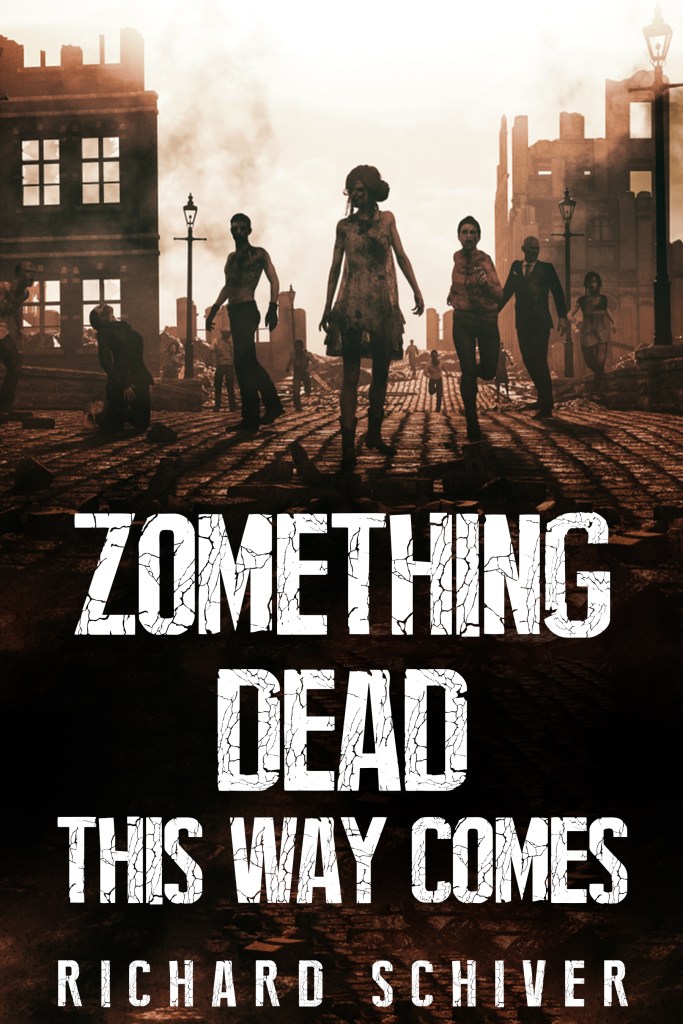
    New Update: Zomething Dead This Way Comes will be off to the editor at the end of this month. Had to find another one as my former editor is no longer taking work. It is what it is. See you next time. Be safe.