From Poe to Carpenter.
In the early part of the nineteenth century Edgar Allen Poe visited the South Polar Region in his only novel length work titled: The Narrative of Arthur Gordon Pym of Nantucket. The work relates the tale of the young Arthur Gordon Pym, who stows away aboard a whaling ship aptly named the Grampus. Various adventures and misadventures befall Pym, including shipwreck, mutiny, and cannibalism, before he is saved by the crew of the Jane Guy. Aboard this vessel, Pym and a sailor named Dirk Peters continue their adventures further south. Docking on land, they encounter hostile natives before escaping back to the ocean aboard the Jane Guy bound for regions even further south. The novel ends abruptly as Pym and Peters continue towards that mysterious region around the South Pole.
It is believed by many that H.P. Lovecraft consciously continued Poe’s tale with his novella, At The Mountains of Madness. That was serialized in Astounding Stories from February to April of 1936. Lovecraft twice cited Poe’s disturbing and enigmatic story in his text, and explicitly borrows the mysterious Tekeli-li cry from Poe’s work. In a letter to August Derleth, Lovecraft wrote that he was trying to achieve with his ending an effect similar to what Poe accomplished in Pym.
In August 1938 the novella, Who Goes There, by John W Campbell writing under the pen name Don A. Stuart was published in Astounding Stories. John never publicly claimed that his novella, Who Goes There? was intended to show H.P. Lovecraft how to write a story. However, literary critics have frequently drawn comparisons between Campbell’s work and Lovecraft’s earlier novella, At the Mountains of Madness, and have noted fundamental differences in their writing styles.
The idea of a direct response to Lovecraft is further supported by the rediscovery of Campbell’s longer, unpublished version of the novella, titled Frozen Hell. A reddit user notes that the longer version “reads almost like a direct sequel to HP Lovecraft’s At the Mountains of Madness,” before Campbell shortened it for publication. This suggests that Campbell’s original text had even stronger allusions to Lovecraft’s work
John Campbell’s story has been adapted for the screen three times. In 1951 as The Thing From Another World, in 1982 as The Thing directed by John Carpenter, and most recently as a prequel to the Carpenter version, also titled The Thing, released in 2011.
The history of this story inspired me to go one step further. In each of the stories above the alien presence never reaches civilization. Until now. I am nearing completion of my trilogy Shadows of the Past, that I’m working to have ready for release as early as next month, if all things go as planned.
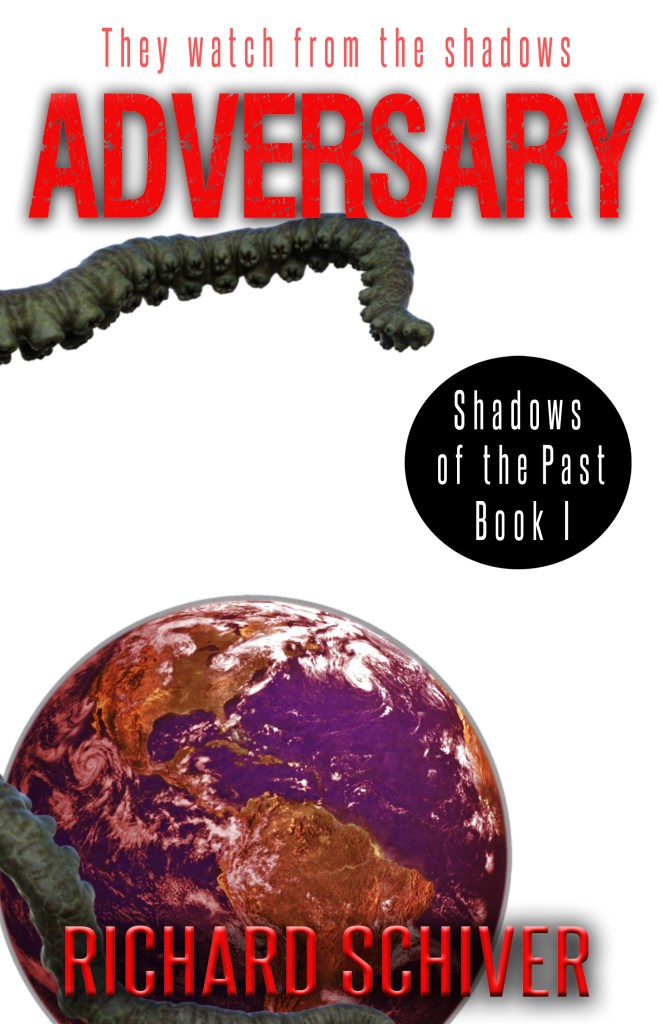
In Adversary, an ancient alien artifact discovered in Antarctica has a strange effect on anyone who touches it. Stolen to repay a gambling debt the artifact is lost and infects Jack Griffith, a sewer worker dying of cancer. The essence of the creature inhabiting the artifact offers Jack hope for a longer life. But is the price worth paying? Below is the proposed cover for the fist installment.
 Richard Schiver