Blog

  • How Everyday Life Sparks Great Writing Ideas

    How Everyday Life Sparks Great Writing Ideas

    One of the most common questions a writer hears is, “Where do you get your ideas?”

    Being the typical smartass that I am, I sometimes reply they come from the idea tree.

    But the real answer, when authors are willing to admit it, is simple, yet elusive. Ideas emerge from some of the most unexpected places. Maybe a fleeting moment, a snippet of conversation, or even a dream. For some, inspiration is rooted in personal experience or observation. Mark Twain famously based Huckleberry Finn on a childhood friend, proving that real life often provides the richest material for fiction.

    Other writers find their muse in the world around them. News stories, historical events, or even graffiti can spark that “what if?” moment that leads to a compelling narrative. Many authors, like Stephen King and Neil Gaiman, describe their ideas as arriving unbidden. Sometimes half-remembered, sometimes fully formed, yet always demanding attention.

    In his book On Writing, Stephen King spoke of ideas using the cup and the handle metaphor. How some ideas do not arrive fully formed and ready to go. But they get catalogued anyway until the idea that represents the handle or the cup arrives to complete the set.  

    But the secret isn’t just in having ideas. It’s in recognizing their potential. Writers train themselves to notice the unusual, the poignant, or the extraordinary in everyday life. They jot down stray thoughts, nurture them, and let them grow into stories. Sometimes, inspiration comes from other art forms, travel, or even the simple act of people-watching.

    For me personally I watch strangers. I work part time at Wally World, and I’ve wasted a few moments building narratives in my mind for the lives of the shoppers around me. Simple little tales that at times uncover a deeper narrative that refuses to be set aside. Like a hidden treasure trove of ideas that emerge from a simple act.

     Every writer’s process is unique. The magic comes with being open to inspiration while being brave enough to follow these ideas to where they ultimately lead. Turning ordinary moments into extraordinary tales.

    Where do your ideas come from?

  • A Conversation with Myself

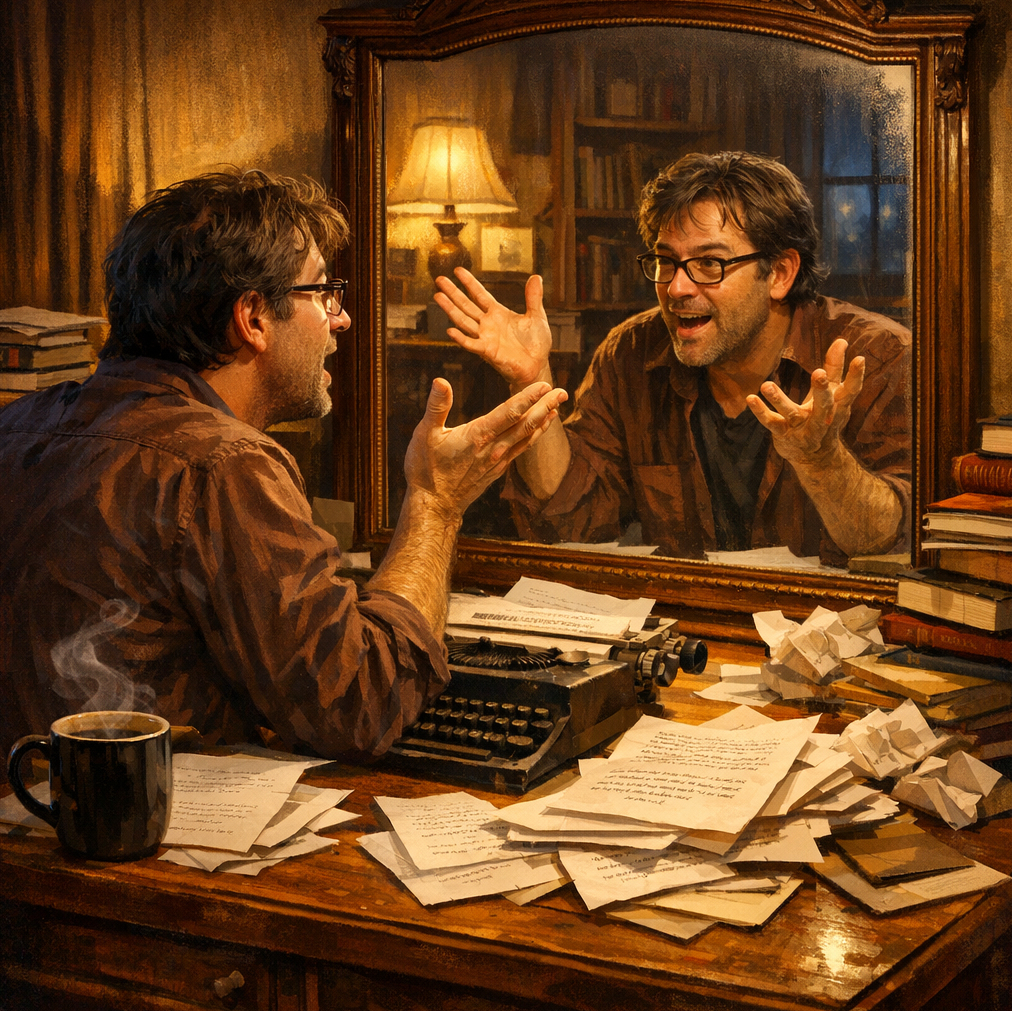
    A Conversation with Myself

    When ancient evil awakens and the line between reality and nightmare blurs, it takes more than a badge to survive. In Adversary, Detective Sam Hardin is forced to confront not only the darkness stalking his city, but the shadows haunting his soul. Grieving, guilt-ridden, and driven by a fierce love for his family, Sam’s journey is as much about redemption as it is about survival.

    Today, we sit down with Sam Hardin to talk about loss, courage, and what it means to face the unknown. Whether you’re a fan of psychological suspense, cosmic horror, or stories of family resilience, Sam’s answers offer a glimpse into the heart of Adversary, and the man at its center.

    1. Sam, your story begins with a heavy burden of grief and guilt. How do you cope with the loss of your wife, Anna, and how does it shape your actions?

    Losing Anna was like losing the sun in my sky. I tried to drown the pain in a bottle, but all that did was push me further from my kids and from myself. Grief is a shadow that follows you everywhere, and guilt. Well, that’s the weight you carry for all the things you wish you’d done differently. Every decision I make, every risk I take, it’s all colored by that loss. I guess, in a way, it’s what drives me to keep fighting, even when the odds are impossible.

    2. As a detective, you’re used to confronting darkness in the world. How did the events at the warehouse challenge your understanding of evil and reality itself?

    I thought I’d seen the worst humanity had to offer. Murderers, thieves, people who’d sell their soul for a quick buck. But what happened at that warehouse. It was something else. Evil isn’t always human. Sometimes it’s older, colder, and it doesn’t care about our rules. That night forced me to question everything I believed about the world, and myself.

    3. Family is central to your journey. What does protecting your children, Cheryl and Frankie, mean to you, especially when the threats become supernatural?

    My kids are all I have left of Anna, and the man I used to be. Protecting them isn’t just a duty, it’s the only thing that gives my life meaning. When the threats stopped being things I could put handcuffs on, I realized I’d do anything, break any law, cross any line, to keep them safe. Even if it meant facing nightmares I couldn’t explain.

    4. You’re haunted by both literal and figurative shadows. Can you describe a moment when you questioned your own sanity during the investigation?

    There were too many moments to count. The dreams, the voices, the feeling that something was watching me from the dark. I started to wonder if I was losing my mind. But when you see things you can’t explain, things that leave bodies in their wake, you stop worrying about sanity and start worrying about survival.

    5. The knife from Antarctica becomes a focal point of terror. What was your first impression of this artifact, and how did your feelings about it evolve as the story unfolded?

    At first, it was just evidence. A weird, ancient knife. But the more I learned, the more I realized it was a key to something much bigger and older than any of us. That knife carried a presence, a hunger. By the end, I didn’t just fear what it could do, I was afraid of what it wanted.

    6. Throughout the book, you struggle with addiction and self-doubt. How do these personal battles affect your ability to lead and make decisions under pressure?

    Addiction’s a liar. It tells you you’re not good enough, that you need something to get through the day. Self-doubt is its partner in crime. There were times I hesitated when I should’ve acted, and times I acted when I should’ve thought things through. But when it came down to it, when my family was on the line, I found a strength I didn’t know I had. Maybe that’s what redemption looks like.

    7. You encounter characters who are both allies and adversaries. Some human, some not. Who surprised you the most, and why?

    Honestly, Michelle surprised me. She stepped up when things got really bad. I always thought I had to carry the weight alone. But she showed me that sometimes, letting someone in is the bravest thing you can do. As for adversaries, let’s just say evil wears a lot of faces, and some of them look just like your own in the mirror.

    8. Dreams and nightmares play a powerful role in your experience. Was there a particular dream that changed your perspective or gave you a warning you couldn’t ignore?

    There was one dream. Anna appeared to me, warning me to protect the child. It felt more real than anything I’d ever experienced. That dream wasn’t just a warning. It was a call to arms. It reminded me that some things are worth fighting for, even if you don’t understand them.

    9. If you could speak directly to readers facing their own “shadows of the past,” what advice would you give them about guilt, redemption, and hope?

    You can’t outrun your shadows, but you can face them. Guilt will eat you alive if you let it, but redemption starts with one choice. One act of courage. Hope isn’t about believing things will be easy; it’s about believing they’re worth the fight. Don’t give up. Even in the darkest night, there’s a dawn waiting.

    10. Without giving too much away, what do you fear most about what’s still lurking in the dark, and do you believe the battle is really over?

    What I fear most is that evil never really dies. It just waits. Maybe we’ll win this round, but the shadows are patient. I’ll keep my eyes open, and I’ll keep fighting. Because as long as there’s something worth protecting, the battle is never truly over.

    Sam Hardin’s story is one of struggle, sacrifice, and the relentless pursuit of hope in the face of overwhelming darkness. As he reminds us, evil may never truly die, but neither does the will to fight for those we love. If you’re ready to journey into the shadows and discover what it takes to stand against the unknown, Adversary is waiting for you. Pick up your copy today. Remember, sometimes our greatest battles are fought not with monsters, but with the ghosts of our own past.

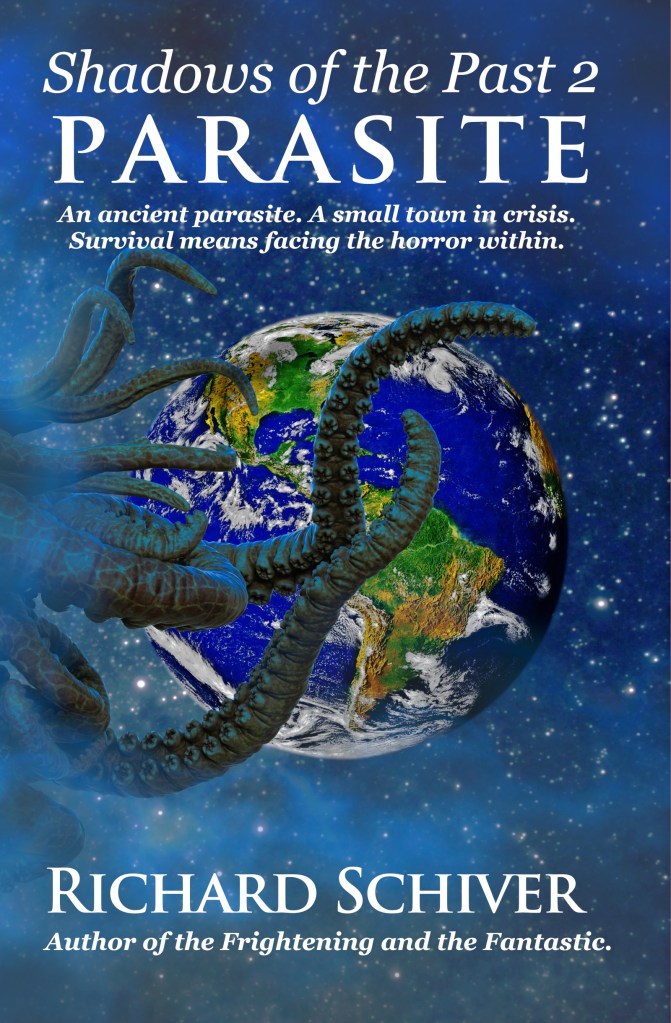
    Click on the cover below to start your own journey into the shadows of the past.

    Haunted by tragedy and driven by guilt, Washington D.C. detective Sam Hardin is thrust into a deadly web of mob intrigue and supernatural terror. When a stolen ancient artifact unleashes an alien power, Sam faces a possessed adversary whose rampage threatens reality itself. As ancient forces rise, Sam must confront his own demons in a battle for redemption, survival, and the fate of his family.

  • Weekly Writing Challenge 01/21/2026

    Weekly Writing Challenge 01/21/2026

    The man in charge looked down upon him, his features twisted with a sadistic cruelty.

    “I thought we had agreed you weren’t going to cause any trouble, boy?”

    Gus shook his head as he worked his mouth silently.

    “Look at this, boys. It thinks it can speak.” The man in charge said. The other hands laughed, Gus’s subdued attacker lying at their feet. The rest of the captives kept their heads down in a submissive manner, their eyes fixed on the bowl in front of them.

    “Maybe a night in the box will teach him his place.” The man in charge said before the emptiness swelled up from the black depths around him to envelope him in its smothering embrace.

    He drifted across a black sea buoyed by a single thought that anchored him to the reality of his past. He was not like the others. He had a life, a family, a wife who loved him. The thought of abandoning her as he had, even though everything that had happened to him up to this point had been out of his control, sent a dagger of guilt into his heart. She would be frantic, not sure what to do, lost within the terror of being deserted.

    What was her name?

    He searched his memory for her name, the throbbing at the base of his skull growing as he struggled to remember even the simplest details of his past life. They had children, or did they? If only he could remember her name, it would strengthen the anchor that tied him to the reality of his past and give him hope to battle the despair his life had become.

    Around him the shadows were deep, the sides of the steel box in which he lay were pressed tight against his shoulders, the crown of his head was wedged against the top while his feet were pressed flat against the bottom. It was a cramped space with a narrow slit along the top that allowed a soft breeze to dance across his naked flesh.

    They had taken his poncho.

    With shaking hands he reached for the top, his palms encountering cold steel as he pushed against its unyielding surface.

    He was trapped within the confines of a box too small for his frame, filled with the need to get up and move around, a restlessness that became the center of his world. Beyond the box the night moved resolutely towards morning, the sky to the east growing lighter as the world continued to turn upon its axis, unaware, uncaring, following a course that had been plotted long before he’d been born and would continue long after he was gone.

    His legs grew even more restless, and he struggled to keep them under control as spasms racked his muscles. He didn’t know how long he’d lain unconscious in the box, but judging by the pain in his legs it had to have been the better part of the night.

    Maybe they’d let him out with the dawn, to work the fields, to move about freely with the others. The thought gave him a goal to focus on as the birds sang in greeting to the approaching dawn, somewhere a rooster crowed as he concentrated on that single thought.

    They were going to let him out soon.

    Somewhere a door slammed, keys jingled, and a muffled shout came from the low-roofed building where the others were being kept.

    As the first light of the coming dawn crested the roof of the barn the doors of the barracks swung open, and the workers were driven towards the building where they had been fed the night before.

    They’ll be coming soon, the thought whispered through his mind, followed promptly by another. They’ll let me out soon. His legs had fallen asleep, his buttocks was numb from resting on the unyielding steel, and the flesh covering the nubs of his shoulder blades felt like it was becoming raw.

    If you’d like to start the story from the beginning follow the link below.

  • Transforming Everyday Moments into Story Ideas.

    Transforming Everyday Moments into Story Ideas.

    I’m running a little late this week. That’s been the story of my life lately while I work to bring my post apocalyptic series to an end. Without further adieu let’s get into this.

    One of the most common questions a writer hears is, “Where do you get your ideas?”

    Being the typical smart ass that I am, I sometimes reply they come from the idea tree.

    But the real answer, when authors are willing to admit it, is simple, yet elusive. Ideas emerge from some of the most unexpected places. Maybe a fleeting moment, a snippet of conversation, or even a dream. For some, inspiration is rooted in personal experience or observation. Mark Twain famously based Huckleberry Finn on a childhood friend, proving that real life often provides the richest material for fiction.

    Other writers find their muse in the world around them. News stories, historical events, or even graffiti can spark that “what if?” moment that leads to a compelling narrative. Many authors, like Stephen King and Neil Gaiman, describe their ideas as arriving unbidden. Sometimes half-remembered, sometimes fully formed, yet always demanding attention.

    In his book On Writing, Stephen King spoke of ideas using the cup and the handle metaphor. How some ideas do not arrive fully formed and ready to go. But they get catalogued anyway until the idea that represents the handle or the cup arrives to complete the set.  

    But the secret isn’t just in having ideas. It’s in recognizing their potential. Writers train themselves to notice the unusual, the poignant, or the extraordinary in everyday life. They jot down stray thoughts, nurture them, and let them grow into stories. Sometimes, inspiration comes from other art forms, travel, or even the simple act of people-watching.

    For me personally I watch strangers. I work part time at Wally World, and I’ve wasted a few moments building narratives in my mind for the lives of the shoppers around me. Simple little tales that at times uncover a deeper narrative that refuses to be set aside. Like a hidden treasure trove of ideas that emerge from a simple act.

     Every writer’s process is unique. The magic comes with being open to inspiration while being brave enough to follow these ideas to where they ultimately lead. Turning ordinary moments into extraordinary tales.

    Where do your ideas come from?

  • A conversation with myself.

    I’m still working on figuring out how to do these interviews with my characters so please bear with me. I’ve renamed the post, after all when I interview a character, I’m having a conversation with myself. This week I talk to Susan, the lead character in my novel Cursed.

    Susan is a middle-aged woman in her late thirties who takes care of herself and has a positive outlook on life. Slender with straight brown hair kept at an average length. There is warmth in her smile, and her eyes. She seems open and caring to those around her. Yet she carries an aura of sadness, as if there were a weight we cannot see bearing down on her.

    RS: What brought you to Porter Mines?

    S: My husband died in Iraq.

    RS: I’m so sorry for your loss.

    S: Thank you. I wanted our daughter, Christine, to be close to his parents who live in Oakland. The farmhouse in Porter Mines was nearby and was listed at a pretty good price. But had I known what I know now, I would never have moved there.

     RS: Why is that?

    S: Every small town has its secrets. Most are harmless little tales designed to scare kids. Or secrets everyone knows about. Like infidelity among the members of the council. Or certain people looking the other way when members of the council get drunk. Things of that nature. But Porter Mines was different, its secret is dangerous, even more so for my daughter.

    Here Susan becomes visibly upset and struggles to control herself. After a few moments she gets herself under control and wipes away her tears. Christine enters the room, crosses to her mommy and climbs into her lap. She’s a cute little thing carrying a stuffed bunny nearly as large as she is.

    S: I mean I didn’t know my maiden name was associated with the founders of the town who lived under this old curse.

    RS: What curse was that?

    S: According to the stories an old woman in the late seventeen hundreds got sick. The area was mostly virgin forest and there were Indians nearby. The people at the outpost believed she was a witch. They got together and dragged her from her home to burn her at the stake. It was said that with her dying breath she cursed every generation that would stain this land.

    C: That’s the witch, but it’s okay, daddy will take care of us.

    Susan glances at Christine with an expression of sorrow.

    RS: The witch?”

    C: She’s real, I saw her, but nobody believes me.

    RS: How will your daddy protect you?

    Here Christine breaks into a wide smile as she pulls the bunny tight against her chest.

    C: He’s here, in my bunny. If you listen real close you can hear his heartbeat. He told me that as long as I had the bunny with me, he would always be with me.

    RS: Did you dad buy the bunny for you?”

    C: No, he won it. It had to be earned.

    RS: Earned?

    C: That’s what the man at the carnival said. Daddy said it would be cheaper to just buy one. But the man at the carnival said it had to be earned.

    RS: What had to be earned?

    Christine shrugged as she twisted around in her seat to look up at her mom.

    S: He won the bunny at a roadside carnival the day before he shipped out. I got so mad at him because he spent so much money to win it. But looking back I was wrong. The bunny helped us get through the worst of everything after he died. It was a constant reminder of his love for us.

    C: Yeah, that’s what I said.

    RS: What about your parents Susan?

    S: My father died when I was young, and my mother passed several years ago.

    RS: I sense you were not close with her?

    S: Not at all, she’s the reason my brother killed himself. She started listening to a TV preacher and made me and my brother’s life miserable.

    RS: I’m so sorry to hear that. It looks like you’ve adapted.

    S: You can’t live in the past.

    RS: So true. Is there anything you’d like to share with our readers before we go?

    S: If you have children, listen to them when they tell you things that seem made up. They see things we can’t, they believe things we’ve turned our back on, and because of that the night holds a danger we cannot see.

    Cursed

    Click on cover to order

    After the loss of her husband, Susan sought a safe place to rebuild a life for herself and her six-year-old daughter, Christine. Quaint and picturesque, Porter Mines seemed ideal, but Susan soon learns appearances can be deceiving. 

    Like many small towns, the history of Porter Mines was woven in a tapestry of dark secrets. One centered on a witch, who vowed with her dying breath to claim vengeance against those who wronged her. A ghost story rooted in grisly truth. 

    Can Susan protect Christine from a wrath even death couldn’t tame?

    Or will her only child fall prey to the curse of Porter Mines?